
Last updated: June 2026. This guide reflects current UK coaching regulation guidance and recognised professional coaching accreditation pathways.
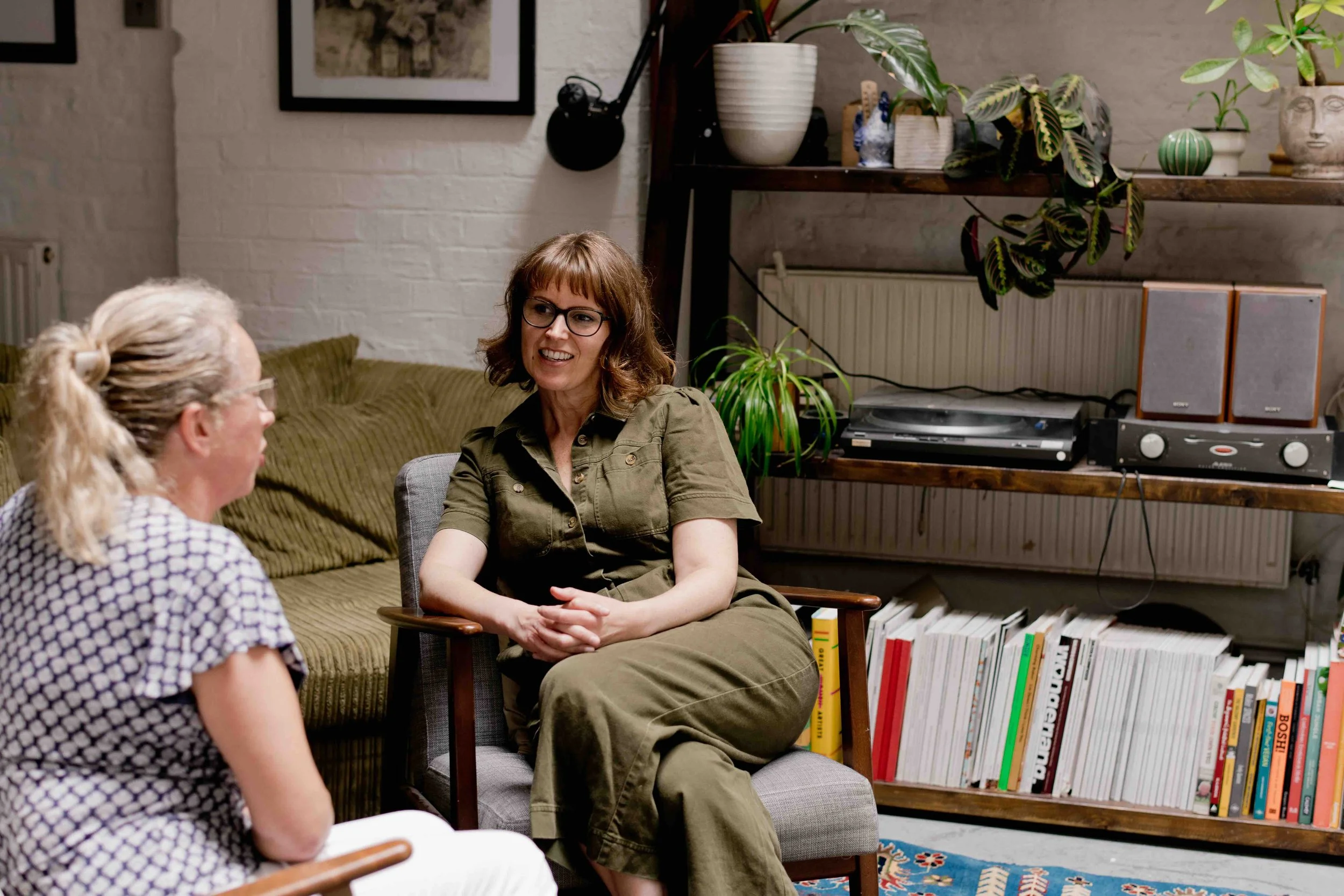
You rarely arrive at this question on a whim. Most people circle it for a while, often quietly, after their own diagnosis in their forties, or a child's, or years of noticing that the work they find most meaningful is helping someone understand themselves. If that is familiar, this guide is for you. It answers the practical question, how you actually become an ADHD coach, and the larger one underneath it, what it really means to become one.
The short version: coaching is not regulated in the UK, so no licence is required, but becoming genuinely good, the kind of coach clients trust and organisations hire, asks for proper training, supervised practice, a recognised accreditation, and a particular way of understanding ADHD and Neurodivergence.
Key Takeaways:
- Coaching is unregulated in the UK, so no licence is legally required. With no regulator, responsibility for quality moves to the learner, which is precisely why training and accreditation matter.
- The strongest route pairs a recognised coaching foundation with a dedicated ADHD specialism, accredited by a recognised body such as the ICF, EMCC or Association for Coaching, with PAAC the body dedicated specifically to ADHD coaching.
- You do not need to be an ADHDer yourself, though lived experience, held well, can be an asset.
- Coaches arrive from many professions, each with transferable strengths and each needing to learn the coaching stance.
- The biggest change in becoming an ADHD coach is usually internal: people come for techniques and leave understanding themselves differently.
What is an ADHD coach?
An ADHD coach is a trained practitioner who works alongside ADHDers to help them understand how their brain works, navigate the parts of life that feel disproportionately hard, and build ways of living and working that fit them rather than fight them. The relationship is collaborative and forward-looking. The coach does not diagnose, provide therapy, or instruct. They partner.
What separates an ADHD coach from a general life coach is specialism. A good ADHD coach understands executive function, emotional regulation, the role of interest and environment, and the particular weight of identity, shame and masking that so often sits underneath the practical struggles. They know where the standard coaching playbook needs adapting for a neurodivergent brain, and they coach the person rather than the problem, holding the whole person, strengths as much as struggles, not just the to-do list.
What is ADHD coaching? And why it is not productivity coaching
ADHD coaching is a partnership that helps an ADHDer move from confusion and self-criticism towards self-understanding, self-regulation and self-directed action. It works in the present and the future, with people who are not seeking clinical treatment, rather than in the clinical territory of the past.
"Behaviour is information, not failure."
– An internal Gold Mind principle
Here is where Gold Mind parts company with a common assumption. ADHD coaching is frequently sold as a sophisticated form of productivity coaching: a set of systems to make a disorganised person organised. We do not see it that way. Productivity sometimes improves, and that is welcome, but it is an outcome rather than the point.
The reason is a principle we return to constantly: behaviour is information, not failure. When someone repeatedly misses deadlines, or avoids a task, or burns out doing work that should be straightforward, the productivity lens asks how to stop the behaviour. We ask a different question. We ask what the behaviour is telling us, and what the person might have needed in that moment. That single shift, from correcting behaviour to understanding need, changes everything about how the work is done. ADHD coaching, done well, is not fundamentally about helping someone perform differently. It is about helping someone understand themselves differently, and discovering that better performance, where it comes, tends to follow from that.

Curious about ADHD coach training?
Join our live Q&A to learn how the training works, what the pathways look like and whether it is the right next step for you. Bring your questions and explore your options.
What is ADHD coach training?
ADHD coach training is structured education that develops two things at once: the core competencies of coaching, and the specialist knowledge required to apply them well with ADHDers. The strongest programmes combine taught content with assessed, supervised practice, so that you do not simply learn about coaching, you become able to coach. Many also map towards a professional credential, which we will come to shortly.
It is worth naming early that training does something most people do not anticipate. We will return to it at the end, because it is the most important part. For now, hold this: good ADHD coach training changes the coach, not only their skill set.
Is ADHD coaching regulated in the UK? Do you need a qualification?

Legally, no. Coaching in the UK sits alongside the other talking professions as an unregulated field. There is no statutory body that licenses coaches, and no qualification you must hold by law before you practise. Anyone can use the title. The government-run National Careers Service confirms as much, stating plainly that life coaching is not regulated in the UK, and that working towards accreditation from a professional body is the way to improve your prospects.
We could stop at the legal facts, but the more interesting point is what follows from them. When there is no regulator standing between a practitioner and a client, the responsibility for quality does not disappear. It simply moves. It moves to the learner. You become the person responsible for ensuring you are properly trained, genuinely competent, and safe to be in difficult conversations with vulnerable people. That is not a loophole to exploit. It is a standard to hold yourself to.
This is also why the credible end of the market behaves as though coaching were regulated even though it is not. Clients investing in themselves, and especially organisations commissioning coaching, increasingly look for recognised training and accreditation, because accreditation is the proxy for the standard that no regulator is enforcing. So while a qualification is not a legal requirement, it is fast becoming a practical one, and more importantly, it is how you take responsibility seriously in a field that leaves that responsibility with you.
What kind of training should you look for?
The strongest preparation has two layers. The first is a grounding in coaching itself: the core skills, the ethics, and the discipline of listening and asking rather than advising. The second is a dedicated ADHD specialism that teaches how those skills land for a neurodivergent brain, where the usual approaches need adapting, and how to work with the emotional and identity dimensions of ADHD rather than only its logistics.
When you compare programmes, look for accreditation by a recognised body. The most relevant are the International Coaching Federation (ICF), the European Mentoring and Coaching Council (EMCC) and the Association for Coaching (AC), and, for this field in particular, the Professional Association for ADHD Coaches (PAAC), the only global body dedicated exclusively to ADHD coaching. Look for a meaningful number of training hours, supervised or observed practice rather than theory alone, mentor coaching, and a clear pathway towards a professional credential if you want one.
Be wary of inexpensive, pre-recorded courses that promise a certificate with no assessed practice. They rarely qualify for recognition by the serious bodies, and they rarely make you a confident practitioner. The cheapest option and the most prestigious option are seldom the most useful comparison. The right question is what will actually make you competent, credible and well supported.
How does ICF accreditation work, and does it matter?
The ICF is the most internationally recognised of the coaching bodies, and its system is worth understanding, because the terminology trips almost everyone up.
Two different things are in play. The ICF accredits training programmes at Level 1, Level 2 and Level 3. Separately, it awards individual coaches one of three credentials: Associate Certified Coach (ACC), Professional Certified Coach (PCC) and Master Certified Coach (MCC). The programme levels feed the credential pathways. A Level 1 programme supports the ACC route, a Level 2 programme supports the ACC and PCC routes, and Level 3 supports the MCC route.
The credentials carry their own thresholds. The ACC typically requires at least 60 hours of coach-specific training and 100 hours of coaching experience, along with mentor coaching and an assessment. The PCC requires at least 125 hours of training and 500 hours of coaching experience. The MCC sits well above that, with around 200 hours of training, 2,500 coaching hours and a previously held PCC. One detail people miss: a training provider gives you the eligibility, but only the ICF itself awards the credential, once you have met the training, mentoring, practice and assessment requirements. These requirements are set, and periodically updated, by the International Coaching Federation itself, so it is worth checking their current standards rather than relying on fixed figures.
For the full detail on accreditation, including why "Level 2" tells you more than a bare "accredited", see our guide to ICF accreditation for ADHD coaches.
A short glossary for aspiring coaches
You will meet these terms constantly, so here are clear definitions you can rely on.
Executive function is the set of mental processes that help us plan, start, organise, hold information in mind, manage time and regulate our actions towards a goal. In ADHD, executive function is not absent, it is inconsistent, and it varies with interest, energy, stress and environment more than with importance.
Regulation is the capacity to manage internal states such as emotion, attention, energy and nervous system arousal so that intentional choice becomes possible. Much of what looks like a behaviour problem is more accurately a regulation problem, which is why supporting regulation often matters more than supplying strategies.
Masking is the effort of hiding or suppressing ADHD traits to appear to meet neurotypical expectations. It can be effective in the short term and exhausting over time, and its hidden cost, in energy, identity and self-trust, is one of the things coaching often surfaces.
Time perception differences describe how ADHDers tend to experience time. We are, in a sense, Now Thinkers: the present is vivid and immediate, while time outside of now is harder to feel, formulate and engage with. This is a difference in how time is experienced, not an absence of awareness, which is why we do not use the older, ableist phrase that frames it as a deficit.
Neurodivergence refers to the natural variation in how human brains work, including ADHD, autism, dyslexia and others. We use it readily because ADHD rarely appears in isolation, and because the wider frame matters: an ADHDer is also a whole person whose experience is shaped by everything else about them.
Curious about ADHD coach training?
Join our live Q&A to learn how the training works, what the pathways look like and whether it is the right next step for you. Bring your questions and explore your options.
Join the Q&ADo you need to have ADHD yourself?
No. You do not need to be an ADHDer to become an excellent ADHD coach. Many skilled, valued coaches are not themselves neurodivergent.
That said, lived experience can be a genuine asset. A coach who knows from the inside what rejection sensitivity, or the particular exhaustion of masking, or the texture of time perception differences actually feels like can sometimes build trust faster and recognise patterns sooner. But lived experience is not a substitute for training, and on its own it can even get in the way, because the temptation to assume "this is how it is for me, so this is how it is for you" runs directly counter to good coaching.
Whether you are an ADHDer or not, the discipline is identical, and it is the discipline at the centre of this whole craft: stay curious about this person's experience rather than generalising from anyone else's, including your own.
Can you become an ADHD coach from another profession?
Most people who train as ADHD coaches are changing direction rather than starting out. The good news is that almost every background brings something useful. The thing to watch, in every case, is the shift in stance that coaching asks for, which is the move from being the expert with answers to being the partner who helps someone find their own.
From teaching
Teachers bring patience, an instinct for how people learn, and real comfort with structure and progression. The adjustment is moving from instructing to drawing out. Coaching is not delivering a curriculum or correcting errors, it is helping someone find their own way forward, which can feel counterintuitive after years at the front of a class.
From therapy or counselling

Therapists and counsellors bring deep listening, an understanding of emotional process, and respect for safety. The key distinction is scope. Coaching works in the present and future with people who are not seeking clinical treatment from the coach, not in the clinical territory of diagnosis and treatment. Many therapists make outstanding coaches precisely because they can hold difficult material, provided they consciously step out of the treating role.
From HR, learning and development, or management
People from these fields bring organisational awareness, experience of developmental conversations, and credibility with employers. The shift is from advising and managing outcomes to facilitating someone else's thinking without steering it towards the answer you would have chosen.
From healthcare or occupational therapy
Clinicians and occupational therapists bring a sophisticated understanding of how people function day to day, and of the practical scaffolding that helps. The adjustment is loosening the impulse to assess and prescribe, and trusting the coaching process to let the person lead.
From psychology
Psychologists bring a rich grasp of how minds work and a research literacy that strengthens their judgement. The watch-point is similar to the therapist's: coaching is not assessment or formulation, and the expert frame, however well earned, needs setting aside so that the person's own expertise on their own life can come forward.
What skills and qualities make a good ADHD coach?
Beyond technique, the coaches who do this well tend to share a handful of qualities. They can regulate themselves, staying calm and present when someone is overwhelmed. They are genuinely curious rather than quick to fix. They can sit with discomfort, including shame and grief, without rushing to make it better. They are flexible, adapting to a brain that varies from day to day. And they hold a strengths-based but realistic view, neither dismissing ADHD as a mere obstacle nor reaching for the tired line that it is simply a superpower. The craft is honest nuance: real strengths, real challenges, and a person who is more than either.
That strengths-based stance deserves a word of its own, because it is easy to underestimate. Gold Mind coaches the person, not the problem, and that is harder than it sounds with ADHDers, who often carry high expectations of themselves and a strong negativity bias that pulls attention onto what is hard. After years of not understanding their differences, many find it genuinely difficult to see their strengths at all. A good coach brings strengths actively into view, and regards them not as a feel-good extra but as a more honest language for how a person shows up. When things go well, strengths help explain how and why, which matters because ADHDers so often put success down to luck or to other people rather than to themselves. Helping someone reconnect those dots is part of shifting from looking outward for validation to building it from within, and that internal validation is where self-trust, and eventually genuine voice and choice, begin.
There is also an intersectional awareness that the best coaches carry. No ADHDer experiences ADHD in a vacuum. The same trait can be read as charming in one person and unprofessional in another, accommodated for one and penalised for another, recognised early in one group and missed for years in another. It is widely acknowledged that diagnosis has historically been skewed, with women, and people from marginalised communities, far more likely to be overlooked or misread. A good coach holds this in mind, and avoids assuming that what is true for one ADHDer is true for all.
The practical questions
How long does it take, and what does it cost?
Honestly, it varies, and you should be sceptical of any single figure. Timelines depend on the depth of the programme and how much supervised practice it includes. The ICF thresholds give a sense of scale, since even the entry-level ACC expects at least 60 training hours and 100 coaching hours, so a serious foundation is a matter of months rather than weeks. Cost varies just as widely, driven by accreditation level, hours, whether there is live teaching and mentor coaching, and the quality of support. Rather than trust a number you read in passing, look at what a programme actually includes and weigh it against the level of accreditation and practice on offer.
Can you do this part-time, alongside a job?
Yes, and many people do. Studying around work and family is common, and a well-designed programme will be clear about hours, pacing and delivery so you can plan. Coaching alongside an existing job, before stepping across fully, is often the wisest way to make the transition.
How much coaching practice do you need?
More than a course alone provides on paper, which is why supervised practice hours during training matter so much. The ICF credential thresholds, 100 hours for the ACC and 500 for the PCC, are a useful benchmark for how much real coaching it takes to become genuinely fluent.
Can you become self-employed as an ADHD coach?
Yes. Most ADHD coaches build a private practice, working one to one, sometimes alongside group programmes or workshops. For many, the appeal is precisely that the work can be built to fit a life rather than the other way round.
Do employers hire ADHD coaches?
Increasingly, yes. Organisations commission coaching to support neurodivergent employees, and this is one of the areas where recognised accreditation tends to be expected as a baseline.
Can you work internationally?
Coaching travels well, particularly online, and credentials from an international body such as the ICF carry recognition across borders. Be mindful that what counts as good practice, and what clients expect, can vary by culture and context.
Can you specialise further?
Yes, and many coaches do, niching by client group, by setting, or by the kind of work they most want to do. A clear specialism often makes a practice both more effective and easier to find.
What mistakes do new ADHD coaches make?
The most common is reaching for tools and strategies too quickly, trying to fix the behaviour in front of them rather than getting curious about the need underneath it. The second is importing their own experience, assuming that what helped them will help everyone. Both are understandable, and both are exactly what good training, and the Gold Mind stance, are designed to unlearn.
Gold Mind Perspective: the real transformation
One of the biggest misconceptions about becoming an ADHD coach is that the journey is mainly about learning techniques.
In our experience, the most significant shift is internal.
Many people arrive hoping to collect better tools for helping others. They leave having fundamentally changed the way they understand themselves.
The question changes from "Why did I do that?" to "What might I have needed?"
Only once you have made that move for yourself does it become possible to offer it to someone else, with genuine curiosity rather than judgement. You cannot guide someone from self-criticism to self-understanding along a path you have never walked. This is why we say, often, that you do not become an ADHD coach by collecting more strategies. You become one by learning to understand, beginning with the person you have usually judged most harshly, which is yourself.
So, what does it actually mean to become an ADHD coach?
It means learning a real craft, with real standards, in a field that, because no one regulates it, asks you to hold those standards yourself. It means training properly, practising under supervision, and choosing accreditation as a way of taking the work seriously.
But underneath all of that, it means something quieter. It means becoming someone who has stopped asking what is wrong with them and started asking what they needed. It means coming to see behaviour as information rather than failure, and understanding that awareness and regulation are what create genuine voice and choice, in your clients and in yourself. The technique is learnable. The career is genuinely possible. And for a great many people, the part that lasts is not the qualification. It is the change in how they understand themselves, and the fact that this change is precisely what allows them to help anyone else.
If you have read this far, you are probably not idly curious. You are deciding. And circling a decision like this for a while, sometimes a long while, is completely normal.
Frequently asked questions
Is ADHD coaching a recognised profession?
Coaching is well established but not statutorily regulated in the UK. Recognition comes through accreditation by professional bodies such as the ICF, EMCC and Association for Coaching, and the ADHD-specialist Professional Association for ADHD Coaches (PAAC), rather than through a government licence.
Do I need a degree to become an ADHD coach?
No. There is no degree requirement. What matters is recognised coaching training, a credible ADHD specialism, and supervised practice.
Can I become an ADHD coach without any coaching experience?
Yes. Most people start without it. A good accredited programme builds your skills and gives you supervised practice hours, so you gain experience safely before working independently.
Is it too late to retrain in my forties or fifties?
No. Many people train at this stage, often after their own diagnosis or a career that has stopped fitting. Life experience tends to be an asset in this work, not a disadvantage.
How is an ADHD coach different from an ADHD therapist?
A therapist works clinically, often with mental health and the past. A coach works in the present and future with people who are not seeking clinical treatment from the coach, focusing on understanding, regulation and self-directed change. The two can complement one another.
Can I coach ADHDers if I am not an ADHDer myself?
Yes, with proper training and a genuinely curious, non-assuming stance. Lived experience can help, but it is neither required nor sufficient on its own.
Can ADHD coaching be done online?
Yes. A great deal of ADHD coaching happens online, which also makes it possible to work with clients across different places.
Is ADHD coach training worth it?
That depends on what you want from it. If you are after a quick certificate to add to a profile, a serious accredited training is a significant commitment of time and money, and may feel like a lot. If you want to do this work properly, and to be changed by it as well as qualified, the value is both practical and personal: the skills and accreditation to practise, and, for many people, a markedly different relationship with themselves. It is honest to say it is a real investment, which is exactly why it is worth choosing a programme whose depth matches the commitment.
Whenever you are ready, you can explore the Diploma in ADHD-Specialist Coaching to see exactly what the training involves. There is no rush. Circling a decision like this for a while is completely normal.

About the Author
Alex Campbell is an ICF credentialed ADHD Coach, PAAC Credentialed ADHD Coach, BACP psychotherapist, keynote speaker and author. He specialises in ADHD and neurodiversity training for adults and organisations, supporting confidence, capability and psychologically safe practice.